

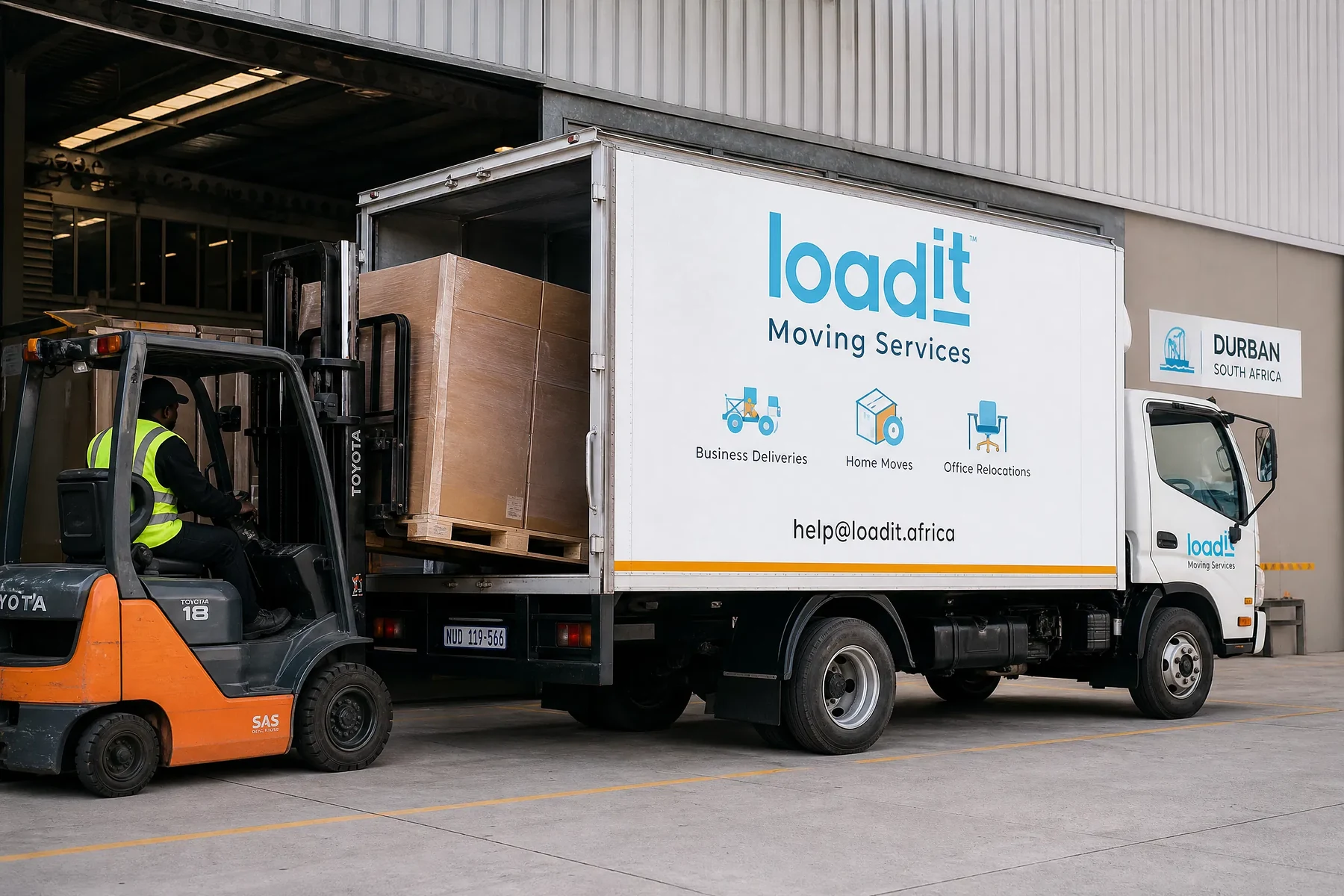
Loadit has found the part of the market that most moving companies ignore, then written itself around it. A couch, a fridge, three office desks, one urgent supplier collection, a student room, a storage unit, a branch transfer. Those are not side cases. They are the search demand.
That is why the company’s content works. It does not speak to “moving services” in the abstract. It breaks demand into the jobs people actually type into search, then matches each job with a page, a vehicle size, a service promise, and proof. For service businesses, that is the whole game.
Channel logic
Loadit’s advantage starts with structure. The site separates household work from business work, then drills down again into specific use cases like apartment moves, office relocations, furniture transport, urgent deliveries, storage-unit moves, and retail collections. That is not content fluff. It is channel design.
A site like this captures demand because the queries are already fragmented. Someone in Sandton searching for a single couch does not want a removalist brochure. A warehouse manager in Johannesburg looking for supplier collections does not want domestic moving copy. Loadit gives both users a page that feels made for them.
The stronger move is local density. Johannesburg, Pretoria, Centurion, Midrand, Randburg, Sandton, Roodepoort, Cape Town, Durban, the Southern Suburbs, Northern Suburbs, and the Atlantic Seaboard all appear as operational reality, not decorative place names. That helps the site match local search intent without building thin city pages that say almost nothing.
Audience intent
Loadit is not selling one service. It is selling relief from friction. The customer might be a homeowner, a student, a landlord, a property manager, an estate agent, an SME, a retailer, or an e-commerce operator. Each group has different urgency, different basket size, and different tolerance for cost.
The single-item jobs matter most because they widen the funnel. Many customers do not need a full removal truck. They need one fridge moved from Facebook Marketplace, one dining table collected from a retailer, one bed delivered, or a washing machine taken across town. Loadit’s pitch is built around that reality, and that is why the business can compete against traditional movers that only talk to people with full house loads.
The search intent is also time-sensitive. Last-minute deliveries, same-day collections, emergency moves, and short-notice furniture transport all signal a user who is ready to book now. Pages that answer that intent convert better than generic service copy because they remove the one question the customer cares about first: can you do this quickly, with the right vehicle, and without making me manage the logistics?
Content format
The site uses the formats that local service traffic actually rewards. Service pages handle the main intent. FAQ content catches the long-tail questions people type when they are close to buying. Coverage content builds local relevance. Review snippets add proof. The embedded Google Maps listing reinforces that this is a real business with a physical footprint, not a thin lead-gen shell.
The cleanest example is the way Loadit turns a moving guide into a traffic magnet. A strong guide can pull in broad information-seekers, then hand them off to service pages that convert the narrower, commercial searches. That is the right shape for a service site. Informational content opens the door. Booking pages close the sale.
Loadit also uses specificity as an SEO weapon. It names the items people actually move, beds, couches, dining tables, printers, filing cabinets, boardroom furniture, wardrobes, appliances, archive boxes, and outdoor furniture. That kind of inventory language does two things. It catches varied queries and it reduces doubt. Users can see their own job inside the copy.
The business pages go further with operational detail. LOADIT ESSENTIAL covers ad-hoc and emergency delivery needs. LOADIT PRO is for higher-volume work, custom routing, scheduling, warehouse storage, long-haul movement on the CPT-JHB lane, and consolidated trips. That is the difference between a generic service page and one that understands how different buyers actually purchase transport.
Monetisation fit
Loadit’s model fits the market because it prices convenience, not vehicle ownership. Customers do not need to buy a truck, hire staff, or manage routing. They book the right vehicle and the right labour for the task, from a driver only to a driver with helpers, loading support, offloading support, stairs assistance, and heavy lifting.
The fleet range matters here. Bakkies, half-ton vehicles like NP200-type options, and one-ton bakkies handle smaller deliveries and furniture. One-ton, 1.5 ton, 3 ton, and 8 ton trucks cover home moves, office moves, and larger commercial jobs. That range lets the site serve low-ticket and higher-ticket intent from one brand, which is a better monetisation setup than trying to force every user into the same package.
The pricing story is also stronger than a typical moving company pitch. Pay-as-you-go, no long-term commitments, no need to carry a private fleet, and no labour risk. Loadit even argues that least-cost routing and scheduling can cut costs by up to 40%. Whether a buyer is a homeowner or a procurement manager, that is a persuasive commercial angle because it speaks directly to overhead avoidance.
Examples that show the playbook
The review profile is not decoration. It is a ranking signal, a conversion signal, and a trust signal in one. Loadit shows a 4.9 rating from 1,944 Google reviews, and the comments lean hard into the qualities that matter for local search: easy booking, friendliness, safe handling, and speed. Stacey Mostert, Liz P, Bella Silva, GAVILAN CARLEY, Sharlene Du Toit, Nazreen Hassan, Shiluva Nkuzana, Alison Kelly, Thaveshni Govender, and Susan Joubert all reinforce the same story from different angles.
That matters because service sites do not win by sounding credible. They win by looking booked, reviewed, and operationally real. Loadit says it has been moving goods since May 2017, has completed thousands of tasks, and has handled over 40,000 trips while trusted by 1,000+ businesses. Those numbers are not window dressing. They help the site convert the traffic it attracts.
The clearest lesson here is simple. Loadit did not build one page for one keyword. It built a content system around the many ways South Africans actually need transport. That is why it captures demand in Johannesburg, Pretoria, Cape Town, Durban, and the surrounding business corridors while less disciplined competitors stay buried under generic “moving services” copy.